Carmilla–Laura relationship
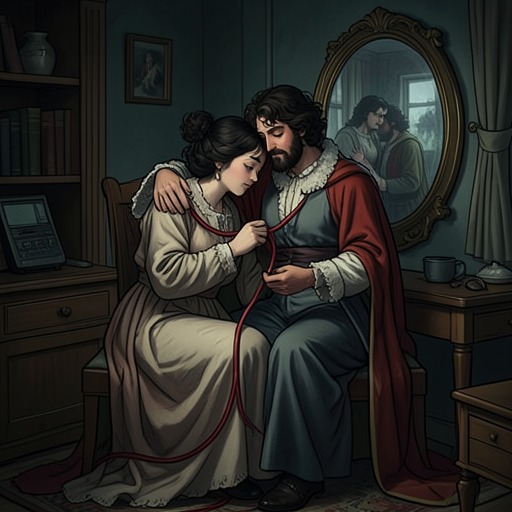
A History of the Vampire in Popular CultureThe Carmilla–Laura relationship is the central emotional and predatory structure of Sheridan Le Fanu’s Carmilla. Carmilla enters Laura’s household as a vulnerable-seeming young guest, becomes her closest companion, and awakens an intimacy that is both romantic and frightening. Behind that companionship lies a vampire’s methodical draining of human life. The relationship therefore turns affection into a source of danger: Laura’s longing gives Carmilla access, while Carmilla’s appetite makes genuine reciprocity impossible.
Identity and First Recognition
Carmilla’s connection with Laura is marked by uncanny recognition before either girl understands its cause. Both young women had experienced a dream in childhood in which they recognized one another, creating an atmosphere of romantically entwined fate from their first meeting. Their bond is reinforced when a restored portrait of Laura’s ancestor Mircalla arrives and bears a striking resemblance to Carmilla. The portrait turns resemblance into a clue, suggesting that Laura’s new companion is not merely familiar but linked to an older identity and history.
Laura is especially receptive to Carmilla because her closest friend has died under mysterious circumstances. Carmilla’s arrival fills an emotional vacancy, and Laura responds gratefully to the companionship offered by the attractive newcomer. That vulnerability gives the relationship its emotional asymmetry. Laura approaches Carmilla as a friend and confidante, whereas Carmilla approaches Laura as both desired companion and potential victim.
Intimacy and Predation
Carmilla’s behavior makes the relationship intimate but never safe. She sleeps through the day, spends each night apparently sleepwalking, and occasionally makes romantic overtures toward Laura. Her nocturnal habits fit the developing nineteenth-century image of the vampire as a creature of the night, while her selective, elegant mode of feeding distinguishes her from older stories of physically ugly revenants. Carmilla is not simply a corpse that returns to attack indiscriminately; she gains entry through charm, proximity, and emotional attachment.
Her refusal to join the family in prayer further marks her as an outsider within Laura’s household. In the early nineteenth-century setting, avoiding communal prayer would have been regarded as a serious stain on a person’s character. The gesture therefore operates simultaneously as a religious warning and a social signal: Carmilla refuses the practices that would place her inside the family’s moral community, even as she becomes increasingly close to Laura.
The relationship’s erotic force is inseparable from its violence. Carmilla is described as emotionally and physically predatory, and Laura’s attraction does not protect her from being consumed. The same closeness that makes Carmilla compelling also allows the vampire to drain her life. Their bond transforms the traditional vampire attack into a disturbing courtship pattern in which seduction, companionship, and feeding occupy the same space.
Discovery of Mircalla’s Identity
The truth emerges through the story of Laura’s dead friend Bertha. Laura and her father encounter General Spielsdorf, Bertha’s uncle, who explains that Bertha had befriended a young woman named Millarca shortly before her death. Millarca had arrived under circumstances almost identical to Carmilla’s arrival at Laura’s home. The names provide the decisive pattern: Millarca is an anagram of Carmilla, while the portrait identifies Carmilla with Mircalla, Laura’s ancestor’s double.
The recognition changes the relationship retrospectively. Carmilla’s intimacy with Laura is no longer an isolated attachment but part of a repeated predatory method. The vampire has appeared under related names, entered households through apparent accident or vulnerability, formed close bonds with young women, and left death behind. Laura’s experience is thus connected to Bertha’s, and the private friendship becomes evidence in a larger process of identification and pursuit.
Laura, her father, and General Spielsdorf travel to nearby Karnstein to locate Mircalla’s tomb so that the vampire can finally be destroyed. Carmilla appears while Laura and the General are alone and reacts with rage, again evading the General’s attempts to kill her. Her resistance exposes the limits of Laura’s personal attachment: whatever tenderness Laura has felt, Carmilla remains an active supernatural threat whose survival depends on continued access to victims.
Conflict, Destruction, and Aftermath
The relationship ends when Baron Vordenburg joins the group and finally destroys the vampiric Mircalla. The ending does not resolve the bond through reconciliation. Instead, the intimacy is terminated by recognition, collective investigation, and physical destruction. Laura survives as the witness to a relationship whose emotional reality cannot erase its predatory consequences.
Carmilla’s destruction also clarifies the pattern governing the story. The vampire can be welcomed into domestic space, but the household’s apparent hospitality becomes the means of its violation. The discovery of the tomb supplies the historical and material proof needed to convert suspicion into action, while the destruction of Mircalla restores a boundary between the living community and the undead intruder. Laura’s bond with Carmilla is therefore both a personal tragedy and the mechanism through which the threat becomes legible.
Sexuality, Otherness, and Genre Significance
Carmilla was an openly gay woman in a nineteenth-century literary culture in which lesbianism was far from regularly acknowledged in public. Whether the story intentionally equated female same-sex desire with evil cannot be established, but the relationship’s combination of attraction and danger gave Victorian readers a form of sexuality that was simultaneously horrifying and titillating. Carmilla’s desire is not presented as a neutral domestic possibility; it arrives through an outsider who violates religious expectations, sleeps by day, feeds by night, and turns emotional intimacy into physical depletion.
That construction made the Carmilla–Laura relationship foundational for later vampire fiction. Earlier tales had imagined blood-drinking beings such as Lamia, Astryiah, the impundulu, the Vrykolakas, and the revenants recorded by Walter Map, but nineteenth-century literature increasingly shaped the vampire as an elegant, selective, and seductive figure. John William Polidori’s The Vampyre replaced ragged shrouds and ugliness with the handsome upper-class predator, while Varney introduced sharpened, fang-like teeth and made the vampire a more psychologically sympathetic figure. Carmilla carried this developing mythology into a specifically female and same-sex register.
The relationship has remained adaptable across media. Vampire Lovers, Roy Ward Baker’s 1970 adaptation, recasts Carmilla through the names Marcilla, Carmilla, and Mircalla and preserves the central pattern of seduction followed by draining. In that version, General Spielsdorf and Laura receive Marcilla after her mother leaves her in their care; Marcilla seduces Laura and gradually drains her life, then departs after Laura’s death and moves on to Emma, whose governess becomes her willing accomplice. The adaptation plays fast and loose with Le Fanu’s story, including a Carmilla who can appear immune to daylight when convenient, but it retains the relationship’s essential structure: intimacy is the route by which predation enters the household.
The enduring force of the Carmilla–Laura relationship lies in its refusal to separate desire from threat. Later vampire narratives could make vampires heroes, anti-heroes, outsiders seeking equality, or figures of comic self-parody, but the relationship established a durable template in which the vampire’s appeal depends on closeness to the victim and in which forbidden intimacy becomes a language for otherness. Carmilla is compelling because Laura does not confront a monster from a safe distance; she confronts a beloved companion whose affection and appetite cannot be cleanly divided.